
For shops that have outgrown the spreadsheet
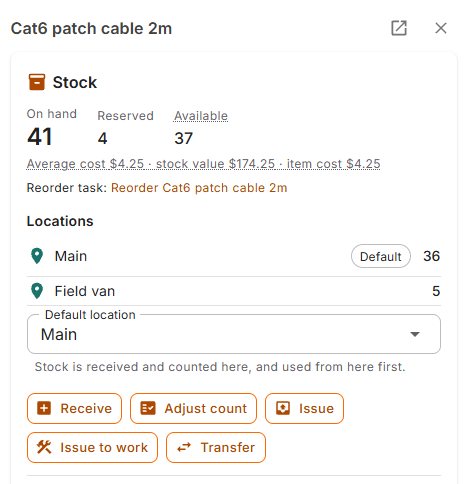
Your stock count says 40. Your shelf says otherwise.
Nexus is job and project management with your stock, customers and people built in. Scan it in, build it on the job, and see what each job really cost.
From a one-person shop to a full plant floor.
Sound familiar?
A Tuesday in the shop, two ways
- 7:40 AM
A pallet arrives. Someone means to update the sheet after lunch.
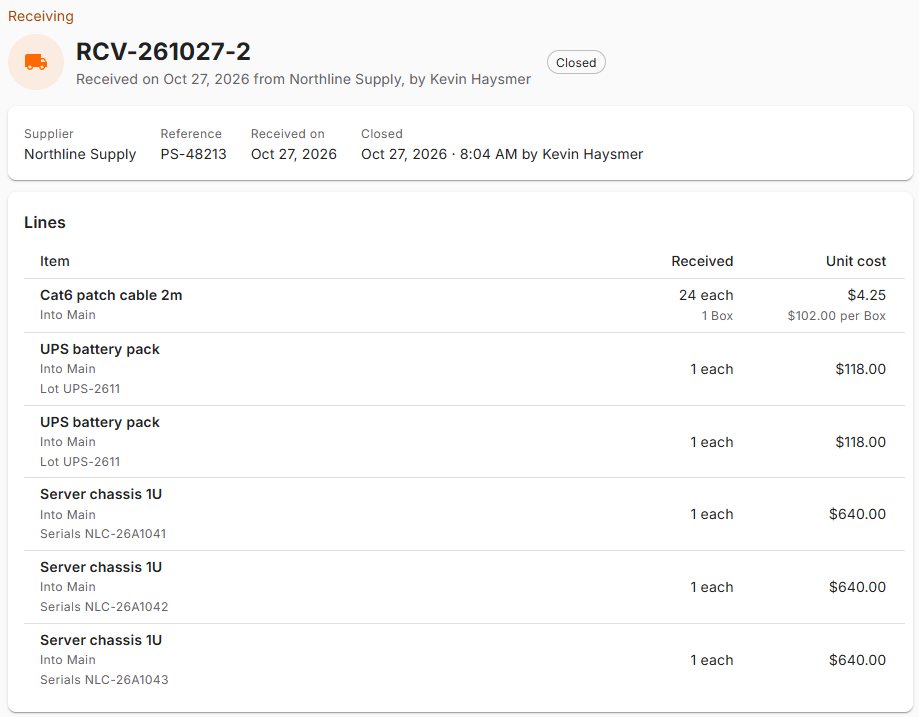
Scanned in at the dock. A box counts as 24 cables, lots and serials get asked for, and cost is recorded on arrival.
- 10:15 AM
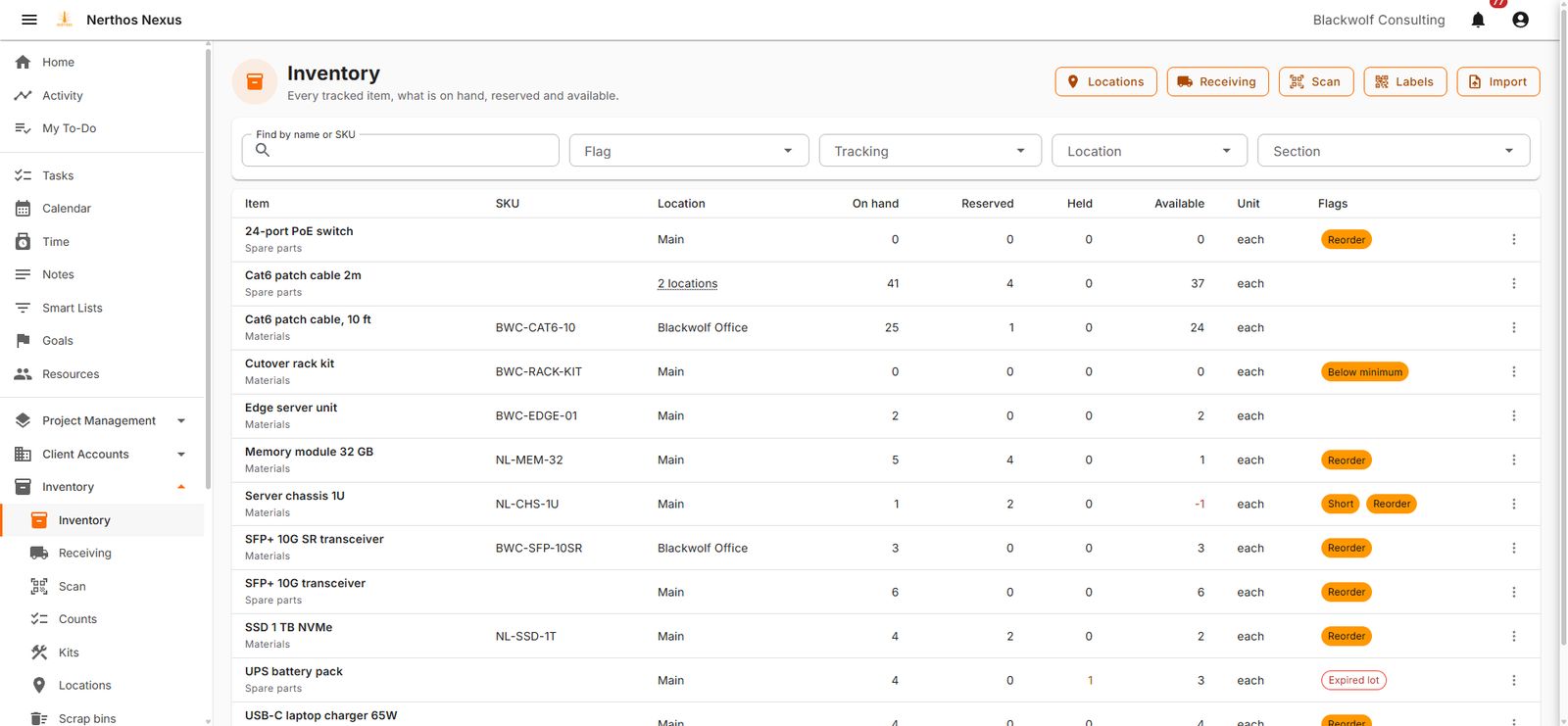
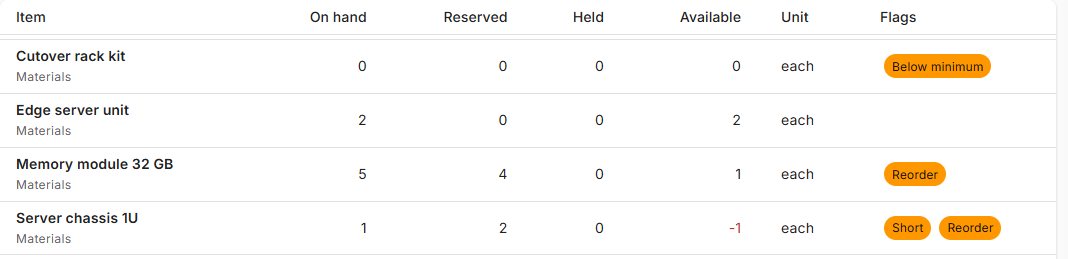
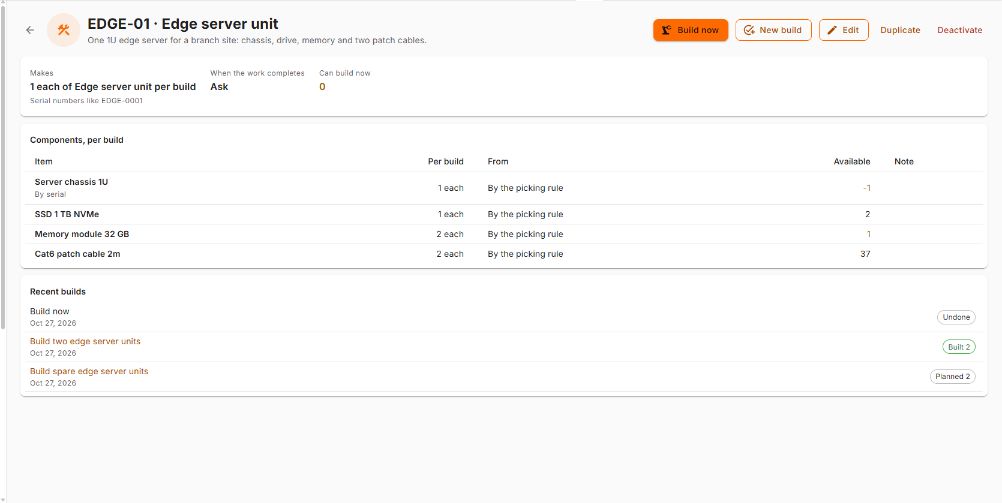
The job is ready to build. The chassis the sheet says you have went into last week's job.
Available means available. Material attached to a job is reserved, the shortage is flagged, and the reorder task already exists.
- 1:30 PM
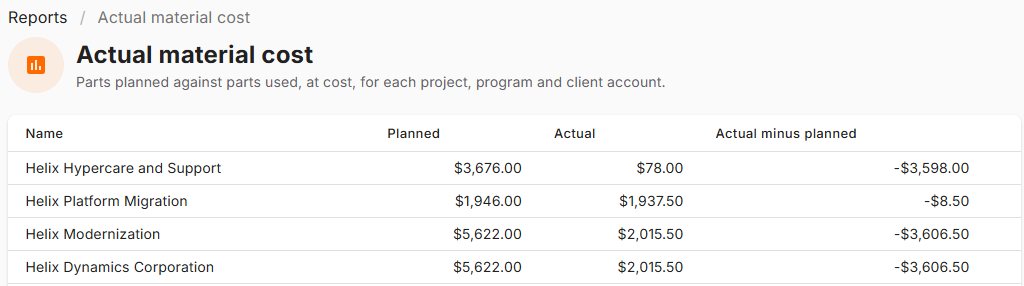
Six sheets of scrap go in the bin. Nobody writes it down.
Scrap lands on the job. Charged with a reason, so what the job really used sits beside what you planned.
- 3:00 PM
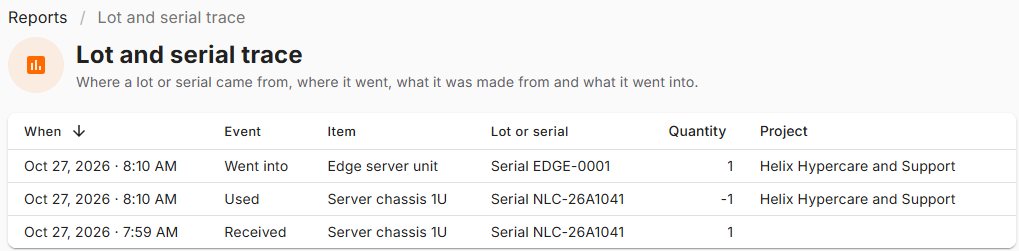
A customer calls about a bad chassis. Which jobs did that batch go into?
One trace report. Received, used on the job, built into unit EDGE-0001. Put the rest of the lot on hold.
- 4:45 PM
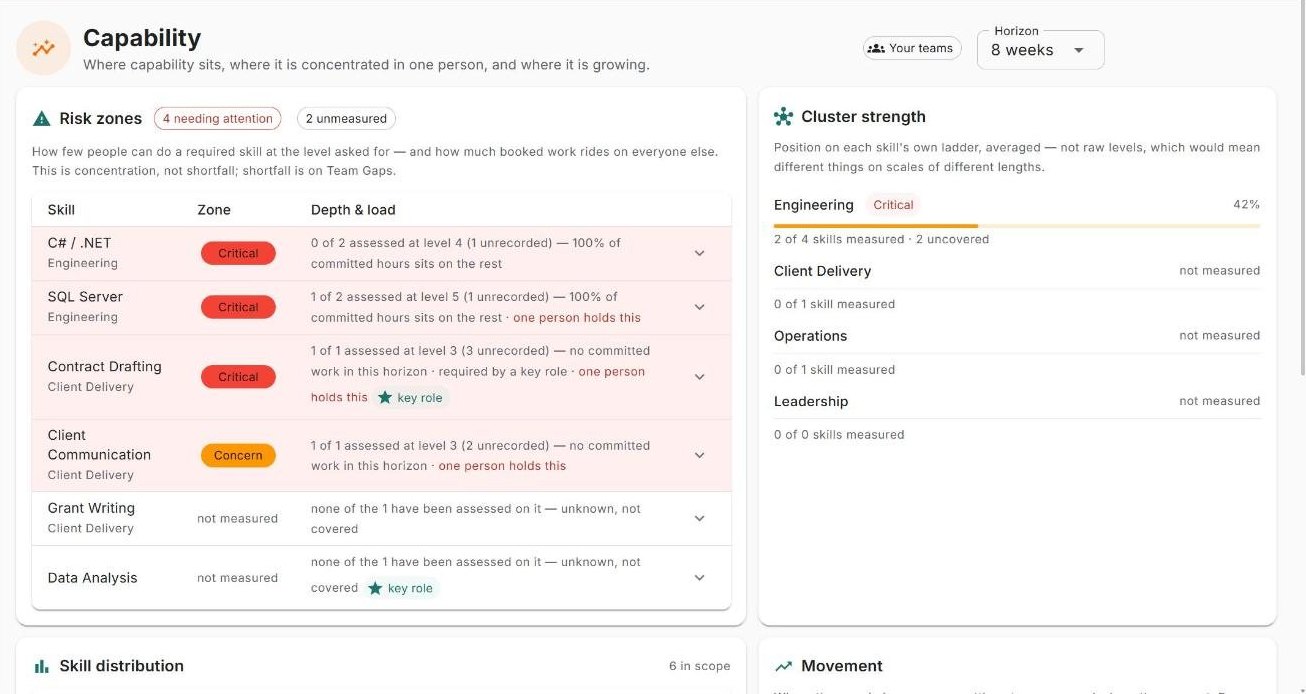
Dave asks for Friday off. Nobody else can run the press.
You saw it coming. The capability heatmap shows the skills that rest on one person, so you train the next one first.
So what is Nexus, exactly?
Job and project management with the rest of the business built in, as one connected record. Follow one part from the dock to the customer:
- ReceivedRCV-261027-2Northline Supply
- SerialNLC-26A1041Server chassis 1U, $640
- Used onBuild two edge server unitsTask
- Built intoEDGE-0001Edge server unit
- ForHelix Hypercare and SupportProject
- CustomerHelix Dynamics CorporationClient account
Every step is a link in Nexus, not a lookup in another file.
Your spreadsheet, your current app, or Nexus?
| Question | A spreadsheet | An inventory app | Nexus |
|---|---|---|---|
| Who changed the count, and why? | Nobody knows. | Usually tracked. | A person, a time and a reason on every movement. |
| What did the job really cost? | The quote, and a guess. | Only if it runs your jobs too. | Planned beside actual, scrap included. |
| Which customer got that batch? | Another file. | Another system. | One trace, from the dock to the customer. |
| Who can run the press? | Ask Dave. | Not its job. | The skill catalog and the heatmap. |
| Purchase orders, shipping, MRP? | Another file. | Often, yes. | Not today. Keep the tool that does them. |
Fewer tools, not one more
Nexus takes over the stock spreadsheet, the job whiteboard, the who's-trained-on-what binder and the lot trace file. Keep your accounting and shipping tools; your lists move between them through Excel.
Ready to move?
Export your items to Excel or CSV. They import with counts and locations, and I'll walk the first import with you.
100% veteran-owned business
Works with what you already use
- OutlookTwo-way calendar sync
- Microsoft 365Sign in with your company account
- Word and ExcelImport and export
- Microsoft ProjectImport
- BoldSignE-signature on contracts
How your data is handled
- Hosted on Microsoft Azure in the United States
- Every customer gets its own workspace
- Company accounts sign in through Microsoft 365, so your own security rules come with you: two-factor, sign-in policies and single sign-on
- Other accounts sign in with a one-time code sent to their email
- An audit trail on every plan
- AI stays off until you turn it on
- Your data is never sold
Everything I'd want to see before a call
No "contact us for pricing." Here's the price, the bugs and the manual.
Mix seat levels in one workspace. Pay Pro or Enterprise for the people who plan the work, and Basic for the people who do it.
| Seats | 10 people | 50 people | 100 people |
|---|---|---|---|
| Enterprise, $49owner, managers | 1 | 3 | 5 |
| Pro, $32planners, office | 2 | 7 | 13 |
| Basic, $12floor: tasks, time, parts used and scrap on their own jobs | 7 | 40 | 82 |
| Inventory Suite$99 + $25 per stockroom seat | 1 | 2 | 3 |
| Per month | $321 | $1,000 | $1,819 |
Pay annually and get 2 months free: $3,210, $10,000 and $18,190 a year.
In beta now, with Enterprise and every suite at no cost until paid plans start in January 2027.
 The tour
Receiving, scanning, kits, builds and job cost, in about 9 minutes.
Known issuesThe bugs we know about, in public, and what's fixed.
StatusUptime, maintenance and every update, with notes.
User guidesA guide for every section, to read or download.
Quick answers
Does it connect to our accounting software?
Not today. Your lists move between Nexus and your accounting system through Excel or CSV.
What scanners work?
Standard USB and Bluetooth barcode scanners.
What does the beta cost?
Nothing until paid plans start in January 2027. Beta workspaces get Enterprise and every suite.
Can we use it for CUI or ITAR work?
Nexus runs in Microsoft Azure's US commercial cloud, not a government cloud, and isn't CMMC certified. Keep CUI and ITAR-controlled data out of Nexus.
Who's behind it
The parts nobody told the line about
A division I supported started adding a bonus part to some of its customer orders. Good idea for the buyer. Nobody told the line that made those parts. The add-ons went straight to the floor, got built and shipped, and quietly used up stock the line was counting on. The line's reorder plan ran on its own sales forecast, and the extras were never in it.
A few months later the line ran out of the components that go into the part. The count that followed found the gap. Then came emergency orders, and too many of them, because nobody could say how many the other division was really using. Overstocked, the line stopped ordering for a while. The other division kept selling. The cycle started over.
Nobody did anything wrong on purpose. The stock just moved where nobody could see it.
In Nexus, every part that leaves the shelf leaves a record: which job, who and why. When the count drops to its minimum, the right person gets the reorder alert, whichever team used the parts.
I'm a certified Six Sigma Black Belt, and I spent my career keeping the systems behind production running in aviation and aerospace. Nexus is the system I kept wishing those teams had.
Kevin Haysmer
Founder & CEO, Nerthos
Bring your worst stockroom headache.
In 20 minutes I'll show you what it looks like in Nexus.
- You tell me what's breaking. The count, the cost or the know-how.
- I show it in Nexus, on a shop like yours.
- You get a straight answer, even if it's "not for you."